
White noise for baby sleep: a safe-use guide
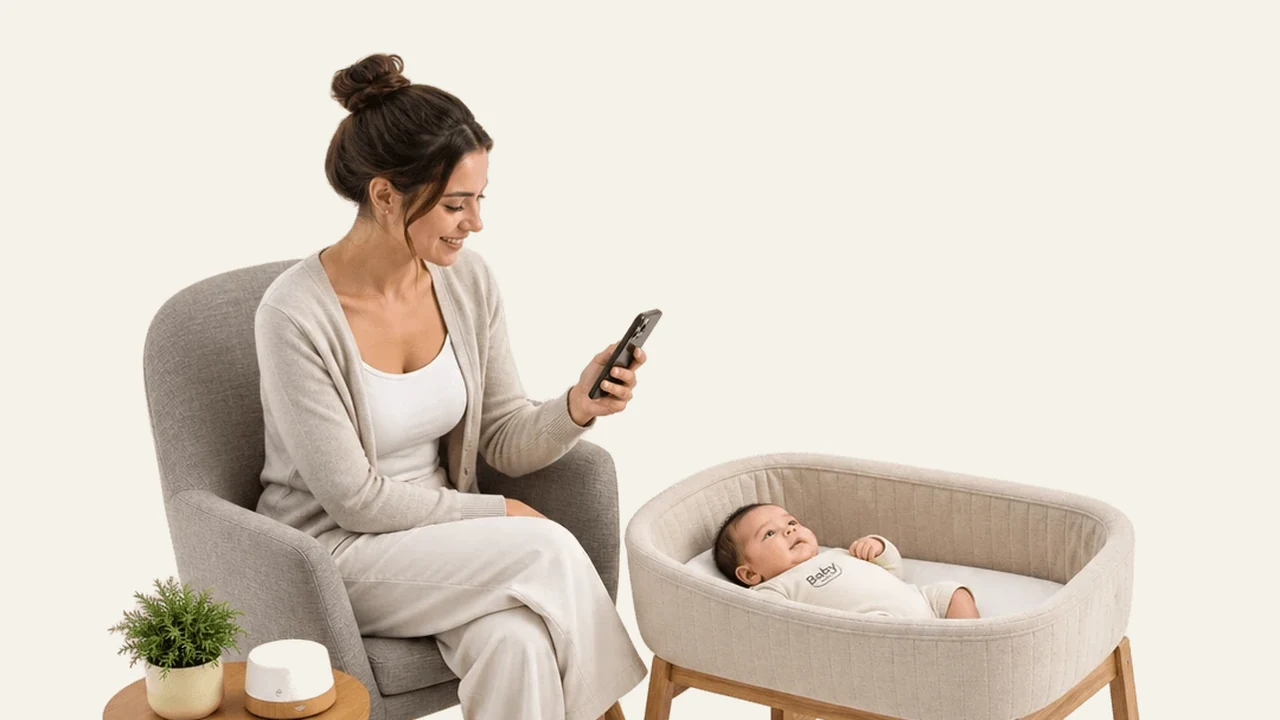
White noise is often marketed as a one-size-fits-all sleep solution. The reality is narrower. It does one specific thing well: it masks the random sounds in a room that would otherwise pull your baby out of light sleep between sleep cycles. For some babies that means noticeably longer naps. For others it makes almost no difference.
Whether to use white noise becomes a much easier question once you understand how it works, what volume is considered safe, and what mistakes to avoid. This guide walks through the practical decisions a parent has to make, in the order they tend to come up.

How white noise actually works
Sleep moves through alternating cycles of deeper and lighter sleep. At the transitions between cycles, your baby briefly drifts up to a more aware state. In that moment, a random sound like a slamming door, a barking dog, or a hallway conversation can be enough to flip the brain into full wakefulness. White noise lays a steady background sound over the room, so isolated sounds no longer stand out, and the cycle transitions go more smoothly.
Two things follow from this. First, white noise helps most in noisy environments: thin walls, traffic outside, older siblings in the next room. Second, it does very little when a baby is waking for internal reasons such as hunger, discomfort, overtiredness, or illness. Sound does not fix overtiredness.
When white noise is worth trying
- There is a constant background you cannot remove: elevators, neighbors, street noise.
- Other children or pets are around, and their sounds are unpredictable.
- Naps cut off cleanly at the 30-40 minute mark, with your baby waking startled or upset.
- Your baby startles easily at sharp sounds (common in newborns under 3 or 4 months with an active Moro reflex).
- Part of the sleep routine happens away from home: travel, visits, renovation noise.
When white noise probably will not help
- Your baby wakes every hour all night and is obviously undersleeping.
- Bedtime fights are long and the evening routine has stretched out.
- Short naps line up with long wake windows just before the nap.
- The room is already close to a normal quiet level.
In these situations, the bigger lever is timing: wake windows, the bedtime routine, the sleep environment. White noise can be a nice addition later, but it will not fix the root issue.
Safety: volume and distance
The main safety concern with white noise is loudness. Many machines marketed for nurseries can deliver sound at the level of a hair dryer. If they sit too close to the crib for many hours, prolonged exposure can affect hearing. The safe-use rules are simple and easy to check with a phone.
- Volume near your baby roughly 50 to 65 dB. That is about the level of a calm conversation or a dishwasher running behind a wall.
- Quiet enough that you can speak in a normal voice next to the source without raising your voice.
- Place the source at least 1.5 to 2 meters (about 5 to 7 feet) from your baby's head.
- No speakers or phones inside the crib, on a side rail, or under a pillow.
- Use a free decibel-meter app on your phone for a rough check. It will not be lab accurate, but it will catch anything well above 65 dB.
If your baby has hearing aids or a known hearing condition, run the use of white noise past a pediatrician or audiologist first.
Choosing a source
Dedicated white noise machine
These are convenient because the sound is predictable and they cannot interrupt themselves with notifications or calls. A good machine delivers a steady continuous sound without loop seams. Cheaper machines often have a short 10 or 20-second loop that your baby's brain notices and treats as a stimulus.
Phone app or smart speaker
These work fine as long as the phone is in airplane mode and the screen does not light up onto your baby. With smart speakers, avoid models with loud indicator chimes or surprise notifications.
Low-tech option: a fan or air purifier
Often the most stable source and one of the cheapest. A bonus: a fan circulates air in the room. Just make sure the airflow does not blow directly onto your baby.
Different types of sound
- White noise: flat across all frequencies, like a TV with no signal. The most universal option for most babies.
- Pink noise: more weight on lower frequencies, softer in tone. Sounds like steady rain or a waterfall. Some babies who find white noise harsh settle better with pink noise.
- Brown noise: even more low-frequency. Reminds people of distant thunder or strong ventilation. Often suits older babies and adults more than newborns.
- Nature sounds (rain, ocean, forest): work similarly to pink noise, but make sure the track is long and has no audible seam every 30 seconds. A short loop is more distracting than helpful.
- Lullabies and melodies: useful for daytime settling and short transitions, but as an all-night background they are too stimulating and too variable.
Building white noise into a routine
- Turn the noise on during the wind-down, not in the last moment before laying your baby in the crib.
- Use the same sound day after day. Switching from rain to ocean to forest weakens its function as a cue.
- For naps you can run it slightly louder than at night. Daytime activity behind the walls is usually higher.
- At night a quieter, steady background is enough to mask incidental sounds without dominating the room.
- If you only use sound for falling asleep, set a 30 to 60 minute timer (many machines do this automatically).
- If you run it all night, ease the volume down in the morning before your baby's usual wake time.
The dependence question
A common worry is that a baby will become unable to sleep without white noise. The behavior of sleeping more easily with a familiar background sound is not addiction. It is a conditioned sleep cue, the same kind as a darkened room or a specific sleep sack. Cues are portable: take the machine or the app with you, and the cue travels.
If you ever want to drop the sound, do it gradually. Lower the volume by 5 to 10 percent every 3 to 5 days. Most babies stop noticing the difference long before the sound is gone.
Frequent mistakes
Too close and too loud
A speaker on the crib rail set to maximum does the opposite of what white noise is meant to do. Instead of masking random sounds, it becomes the loudest thing in the room. If the noise sounds like normal conversation at the doorway, it is already too loud for your baby right next to it.
Constantly switching sounds
When a parent experiments with different tracks every night, the predictability is lost. Pick one sound and use it consistently for at least two to three weeks before deciding whether it helps.
Treating sound as a substitute for timing
If naps are short because the preceding wake window is too long, white noise will not magically stretch them. Adjust the window first (10 to 15 minutes shorter for 2 to 3 days), and only then decide whether you need an audio layer on top.
Starting it only when the baby cries
Switching the machine on as a reaction to crying tends to register as a stress response, not a soothing cue. White noise works better when it has already been quietly playing during the wind-down and continues steadily through falling asleep.
When to check with a pediatrician
- Your baby seems unusually unresponsive to sound, or you have any concerns about hearing.
- Frequent night wakings persist beyond 2 or 3 weeks despite consistent timing and sleep environment.
- Suspected pain, reflux, or breathing issues during sleep.
- Loud snoring, pauses in breathing, or mouth breathing.
Related guides
Keep reading: Bedtime routine checklist: a 20-30 minute frame that works at every age, Short naps: how to fix 30-45 minute catnaps without losing your day. Calculate it for your baby with the Bedtime Calculator.
Try Baby Soma
Personal schedule, AI consultant and sleep tracker - all in one app.
Related reading
Bedtime routine checklist: a 20-30 minute frame by age
A bedtime routine that prevents meltdowns and sets up the night. Five principles, an example sequence, and how it changes as they grow.
Baby only sleeps on me: contact naps and how to transition
Why your baby only naps on you, whether contact naps are a problem, how to keep them safe, and a gentle way toward independent naps.
Baby sleep while traveling: the 48-hour reset plan
What to pack, which routine elements hold the schedule together, how to handle time-zone changes, and how to recover sleep after the trip.